 Sofia Wells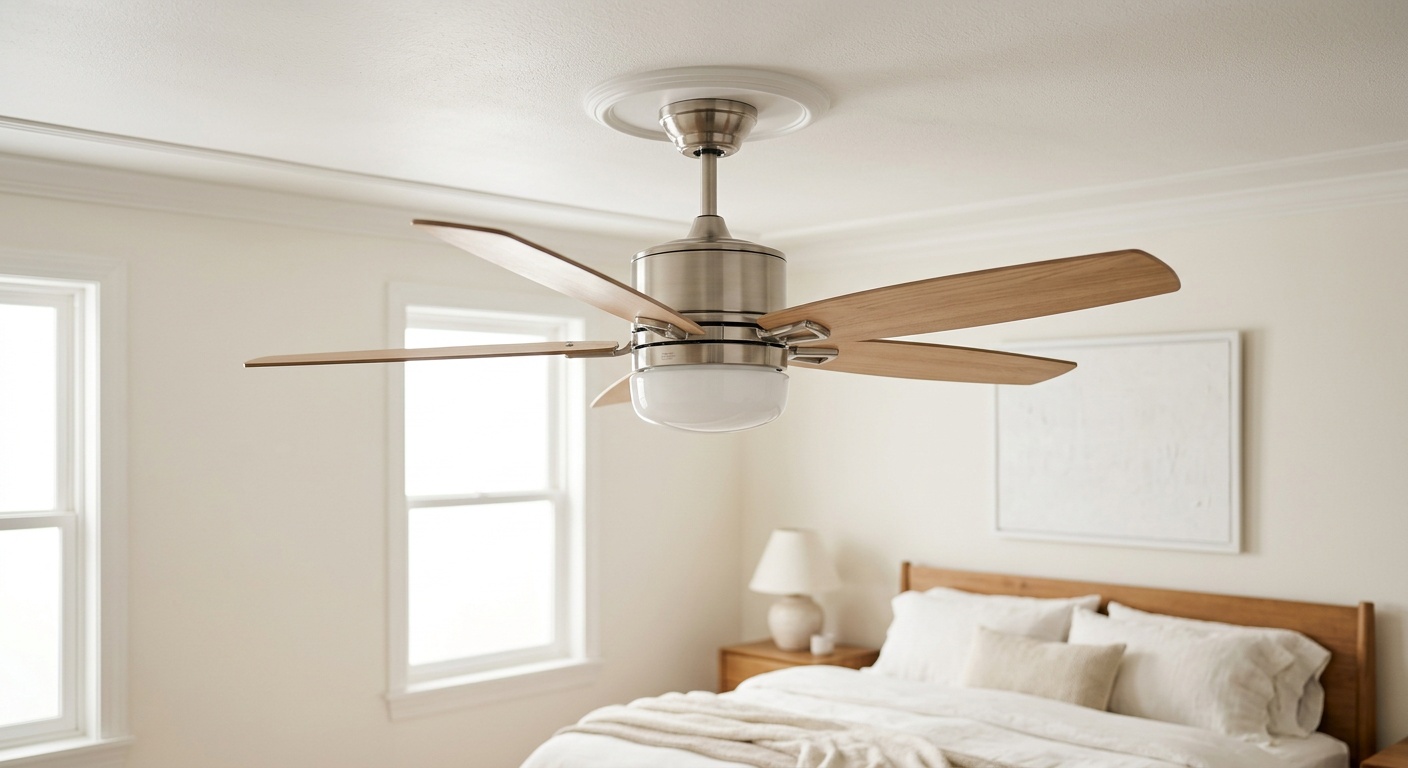
How to Choose the Right Air-Moving Fan for Bedrooms: Your Complete 2026 Guide
Reading time: 14 minutes
Picture this: It’s 2 AM. You’re wide awake, sheets twisted, staring at the ceiling while a stuffy bedroom slowly suffocates any hope of a good night’s sleep. Sound familiar? You’re not alone. According to the Sleep Foundation’s 2025 Annual Comfort Report, nearly 68% of adults identify poor bedroom air circulation as a top disruptor of sleep quality — ranking higher than noise and light pollution combined.
Here’s the straight talk: choosing a bedroom fan isn’t about grabbing whatever’s on sale at your local hardware store. It’s about matching precise airflow mechanics, noise levels, energy efficiency, and room geometry to your personal sleep environment. Get it right, and you’ll sleep deeper, breathe better, and wake up genuinely refreshed. Get it wrong, and you’ll have an expensive, noisy dust-collector sitting in the corner.
This guide cuts through the marketing noise and gets you to a smart, informed decision — fast.
Table of Contents
- Why Fan Selection Actually Matters for Sleep Quality
- Breaking Down Fan Types: Which Category Fits Your Bedroom?
- The Metrics That Matter: CFM, Noise, and Energy
- Reading Your Room: Size, Layout, and Airflow Needs
- Smart Features Worth Paying For in 2026
- 3 Common Mistakes Bedroom Fan Buyers Make
- Side-by-Side Fan Type Comparison
- Noise Level Comparison Chart
- Frequently Asked Questions
- Your Perfect Sleep Environment: A Practical Fan Checklist
Why Fan Selection Actually Matters for Sleep Quality
Most people treat fan shopping the same way they treat buying paper towels — functional, forgettable, interchangeable. But bedroom fans are genuinely different from fans in kitchens, offices, or living rooms. Your bedroom is where your autonomic nervous system does its most critical regulatory work, and ambient temperature plus air movement are two of its most powerful levers.
Research published in the Journal of Thermal Biology confirms that the optimal sleeping temperature for most adults sits between 60–67°F (15–19°C). A well-positioned fan doesn’t just cool the air — it accelerates evaporative cooling from your skin surface, which is the body’s primary self-cooling mechanism. The right fan creates a gentle, consistent breeze without creating drafts that trigger muscle tension or dry out mucous membranes.
Beyond temperature, fans serve a second crucial function in bedrooms: white noise generation. The low-frequency hum produced by quality fans masks sudden environmental sounds — traffic, neighbors, pets — that interrupt light sleep stages. In 2025, the National Sleep Foundation updated its guidelines to acknowledge consistent background noise under 40 decibels as genuinely beneficial for sleep continuity in urban environments.
So when you’re evaluating fans, you’re really evaluating a two-function appliance: a personal microclimate regulator and a passive sound environment manager.
Breaking Down Fan Types: Which Category Fits Your Bedroom?
Ceiling Fans: The Long-Game Investment
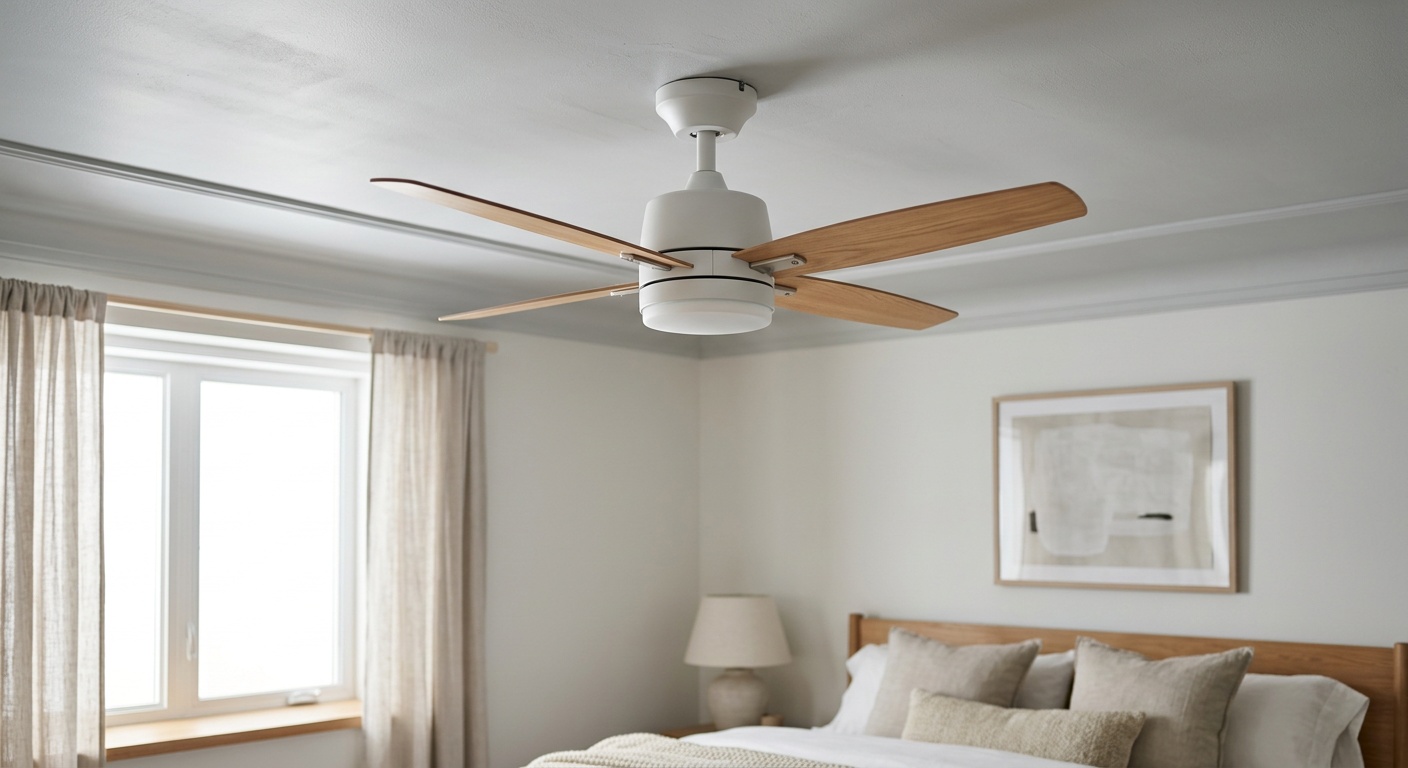
Ceiling fans remain the gold standard for bedrooms with adequate ceiling height (at least 8 feet clearance is recommended). A modern 52-inch bedroom ceiling fan on its lowest setting moves air at roughly 5,000–6,000 cubic feet per minute (CFM), creating a consistent, room-wide airflow pattern that no portable fan can replicate.
In 2026, the ceiling fan market has seen a dramatic shift toward DC motor technology. Unlike traditional AC motor ceiling fans, DC motor fans consume up to 70% less electricity while running significantly quieter. Brands like Hunter, Minka-Aire, and the relatively newer Haiku by Big Ass Fans (now integrated into a broader smart-home ecosystem) offer bedroom-grade DC models that run nearly silent at low speeds — clocking in at 25–32 dB, which is quieter than a whisper.
Case Study — The Hartley Family Renovation, Portland 2025: A couple renovating a 220-square-foot primary bedroom replaced their 20-year-old AC motor ceiling fan with a DC motor model. Their energy monitor showed a drop from 85 watts to 22 watts for comparable airflow. More importantly, their sleep tracking app (Oura Ring 4) reported a 19% improvement in deep sleep duration over the following 30 nights, which they attributed partly to consistent temperature regulation and reduced fan noise.
The trade-off? Installation cost and ceiling structure requirements. If you’re renting or have low ceilings (under 7.5 feet), a ceiling fan becomes impractical or even dangerous.
Tower Fans: Compact Power for Modern Bedrooms
Tower fans have undergone a remarkable technological evolution. The 2024–2026 generation of tower fans uses bladeless or near-bladeless technology with brushless DC motors that produce focused, columnar airflow at dramatically reduced noise levels. Dyson’s 2025 Purifier Cool Gen2 series and competitors from Levoit and Dreo demonstrate what’s now achievable: air purification combined with directional cooling at under 38 dB on medium settings.
Tower fans excel in smaller bedrooms (under 150 square feet) and in rental situations where ceiling fan installation isn’t an option. They’re also portable — you can reposition one toward the bed at night and move it to a corner during the day to maintain aesthetic cleanliness in a bedroom.
The limitation is airflow volume. Even the best tower fans top out around 1,500–2,000 CFM, which means in larger bedrooms or during heat waves, they’ll struggle to maintain comfortable conditions without air conditioning support.
Pedestal and Box Fans: The Practical Workhorses
Don’t dismiss the humble pedestal or box fan. For many bedrooms, especially those in moderate climates or for budget-conscious buyers, a quality adjustable-height pedestal fan remains the most practical solution. The 2025–2026 models from Lasko, Vornado, and Honeywell have improved significantly in noise reduction, with several models qualifying for the updated EPA Energy Star Residential Fan certification introduced in 2024.
Vornado’s whole-room air circulators deserve special mention. Unlike directional fans, Vornado models use a vortex action to move entire room air volumes in a large, circulatory pattern. This approach eliminates the “hot pocket” effect in corners and creates a more even temperature distribution — ideal for irregularly shaped bedrooms or rooms with limited ceiling heights.
The Metrics That Matter: CFM, Noise, and Energy
Understanding three core metrics transforms you from a passive shopper into an informed buyer. Let’s break each one down practically.
CFM (Cubic Feet Per Minute): Your Airflow Benchmark
CFM measures the volume of air a fan moves per minute. For bedrooms, the general rule is:
- Small bedroom (under 100 sq ft): 1,000–2,000 CFM adequate
- Medium bedroom (100–200 sq ft): 2,000–4,000 CFM recommended
- Large or master bedroom (200+ sq ft): 4,000–6,000+ CFM needed
Critical nuance: CFM ratings on packaging are almost always measured at the fan’s highest speed. In a bedroom context, you’ll likely run the fan at 30–50% of maximum capacity to maintain comfortable noise levels. Always check if manufacturers provide low-speed CFM specifications, which are far more relevant for nighttime use.
Noise Level (dB): The Sleep-Quality Factor
Decibels operate on a logarithmic scale, which means a fan rated at 50 dB isn’t slightly louder than one at 40 dB — it’s ten times more acoustically intense. For bedroom use, target these ranges:
- Under 30 dB: Near-silent (library level) — ideal for light sleepers
- 30–40 dB: Gentle background presence — suitable for most adults
- 40–50 dB: Audible but manageable — works for white-noise seekers
- Above 50 dB: Too disruptive for sustained sleep use
Energy Consumption (Watts): The Long-Term Cost
With electricity prices averaging $0.17/kWh across the US in 2026 (up from $0.16 in 2024 per the EIA), running a 100-watt fan for 8 hours nightly costs roughly $0.14 per night — or about $50 annually. A modern DC motor equivalent at 25 watts drops that to under $13 per year. Over a 7-year fan lifespan, that’s a $260 difference — often exceeding the price premium of the energy-efficient model itself.
Reading Your Room: Size, Layout, and Airflow Needs
Your bedroom isn’t just a number on a floor plan — it has geometry, obstacles, and microclimates that fundamentally shape airflow behavior. Here’s how to assess yours honestly.
Step 1 — Measure and calculate volume, not just area. A 150-square-foot bedroom with 9-foot ceilings contains 1,350 cubic feet of air. A 150-square-foot room with 12-foot ceilings contains 1,800 cubic feet. Higher ceilings demand either higher-CFM fans or ceiling fans positioned at the optimal 7–8 foot height from the floor using downrods.
Step 2 — Identify your thermal problem source. Is your room hot because of a sun-facing wall? Poor insulation above? An adjacent bathroom generating humidity? Each situation calls for different airflow strategies. A room overheating from solar gain benefits most from a fan that accelerates evaporative cooling on the body — meaning a directional fan aimed at the bed. A room with poor air exchange benefits from a whole-room circulator that keeps air moving throughout the space.
Step 3 — Map your furniture layout against fan placement. The most powerful ceiling fan in the world underperforms if a bed canopy, tall headboard, or heavy drapes disrupt airflow paths. Visualize the air column moving downward from the fan and consider whether it reaches the sleeping surface unobstructed.
Quick Scenario: Imagine your bedroom has an L-shaped layout — a common configuration in older homes. A single ceiling fan centered in one section of the L will leave the other section stagnant. Here, the smart solution is either a second smaller ceiling fan, or a supplemental tower fan in the secondary zone. Recognizing this geometry issue upfront prevents expensive post-purchase frustration.
Smart Features Worth Paying For in 2026
The 2026 bedroom fan market is saturated with “smart” features, many of which are genuine value-adds and some of which are pure marketing fluff. Here’s an honest breakdown of what actually improves your sleep environment.
Genuinely valuable features:
- Sleep timer with gradual speed reduction: Fans that slowly step down from medium to low over 1–2 hours mirror natural room cooling and prevent you from waking cold at 4 AM.
- Auto-mode with room temperature sensing: Dynamically adjusts speed based on ambient temperature. Models from Dreo and Dyson have refined this to be genuinely responsive rather than laggy.
- Voice assistant integration (Alexa/Google Home): Practical for late-night adjustments without reaching for a remote or fumbling with an app. By 2026, over 73% of new smart fans support Matter protocol, ensuring cross-platform compatibility.
- Reversible airflow direction: Ceiling fans with winter-mode reverse settings recirculate warm air trapped at ceiling level — reducing heating costs by up to 15% in winter months.
Features that sound impressive but rarely matter in practice:
- Built-in aromatherapy diffusers (inconsistent output, maintenance-heavy)
- Color-changing LED lighting (novelty fades fast, usually too bright for sleep)
- App-based “personalized wind patterns” (overly complex for minimal benefit)
3 Common Mistakes Bedroom Fan Buyers Make
Mistake #1: Prioritizing speed over silence. The most frequent bedroom fan regret reported in 2025 consumer surveys? Buying a high-powered fan that turns out to be too loud at every usable speed. Always prioritize dB ratings over maximum CFM when the primary use case is sleep. A quieter fan moving 2,000 CFM beats a loud fan moving 4,000 CFM if you have to run it at its lowest, least-efficient setting to tolerate it.
Mistake #2: Ignoring oscillation patterns in relation to bed position. Many buyers set fans to oscillate without considering whether the oscillating arc actually covers the sleeping position. An oscillating fan covering a 90-degree arc pointed at a wall for half its rotation wastes airflow and creates uneven cooling. Either disable oscillation and aim directly at the bed, or position the fan so the full arc sweeps the sleeping area.
Mistake #3: Overlooking filter and maintenance requirements. Combination air purifier-fans (increasingly popular in 2026) require filter replacements every 6–12 months at costs ranging from $20 to $80. Many buyers factor in the upfront cost but ignore the lifetime maintenance cost. A $150 purifier fan with $60/year filter costs will exceed the total cost of a simpler $200 fan within 3 years.
Side-by-Side Fan Type Comparison
| Feature | Ceiling Fan (DC) | Tower Fan | Pedestal Fan | Whole-Room Circulator |
|---|---|---|---|---|
| Avg. CFM (Low Speed) | 1,800–2,400 | 400–700 | 600–1,000 | 700–1,200 |
| Noise Level (Low Speed) | 25–32 dB | 35–42 dB | 38–48 dB | 32–40 dB |
| Energy Use (Low Speed) | 12–25 W | 15–30 W | 25–45 W | 20–35 W |
| Best Room Size | 150–400 sq ft | Up to 150 sq ft | 100–200 sq ft | 100–300 sq ft |
| Avg. Price Range (2026) | $120–$450 | $60–$350 | $40–$150 | $50–$200 |
Noise Level Comparison Chart: Fan Types at Low Speed
The chart below visualizes average low-speed noise levels across the four main bedroom fan types. Lower bars represent quieter operation — the key factor for sleep-friendly use.
*Values represent typical averages at lowest usable speed setting. Individual models vary. Target: under 40 dB for sleep use.
Frequently Asked Questions
Is it safe to sleep with a fan running all night in a bedroom?
Yes, for most people, sleeping with a fan running all night is safe and beneficial. The primary concern is air dryness — fans accelerate evaporation, which can dry out nasal passages and throat over extended periods. If you experience dryness symptoms, a small bedside humidifier running simultaneously can fully offset this effect. People with severe dust allergies should ensure their fan and room are kept clean, as fans can circulate airborne particles. Modern fans with HEPA-rated purification filters (increasingly standard in 2026) actively reduce particulate levels, making them safer than older fan-only designs.
What fan size do I actually need for a 12×12 foot bedroom?
A 12×12 foot bedroom (144 square feet) sits in the sweet spot for multiple fan types. For a ceiling fan, a 42–52 inch diameter model is optimal — Energy Star recommends 44 inches as the sweet spot for rooms under 175 square feet. For a portable fan, a tower or pedestal fan rated for up to 150–175 square feet will provide sufficient airflow. At typical low-speed operation, you want at least 1,200–1,500 CFM to feel noticeable air movement across the sleeping area. Avoid undersized fans that run constantly at maximum speed — they’ll be louder and wear out faster.
How much does running a bedroom fan really add to my electricity bill?
Less than most people expect. A modern DC motor ceiling fan running at low speed uses approximately 15–25 watts. At the 2026 US average electricity rate of $0.17/kWh, running it for 8 hours nightly costs roughly $0.02–$0.034 per night, or $7–$12 per year. Even an older, less efficient AC motor pedestal fan at 65 watts runs only about $0.09 per night — around $32 annually. The real cost differential between efficient and inefficient fans shows up over a 5–10 year ownership period, where DC motor fans save $100–$250 compared to conventional AC models at equivalent usage levels.
Your Perfect Sleep Environment: A Practical Fan Checklist
You now have everything you need to make a confident, informed decision. But let’s distill this into immediate, actionable steps — because the gap between knowledge and action is where most people stall.
Your 5-Step Fan Selection Checklist:
- Measure your room: Calculate both square footage and ceiling height. Determine whether you have a ceiling fan mounting box already installed (a $10 voltage tester from a hardware store confirms this in minutes).
- Define your primary priority: Is it maximum silence, maximum airflow, energy efficiency, air purification, or portability? Rank these honestly — you cannot fully optimize for all simultaneously at any budget tier.
- Set a realistic budget including lifetime costs: A $200 DC ceiling fan over 8 years costs far less than a $70 AC motor fan replaced twice in the same period. Factor in filter replacements for purifier-fans.
- Check dB ratings at low speed specifically: Ask manufacturers directly for low-speed noise data if packaging only shows high-speed ratings. Any reputable brand will provide this. Walk away from any fan that cannot demonstrate sub-40 dB operation at its intended sleep-use speed.
- Test placement before committing: If buying a portable fan, position it in your bedroom for one full week before returning — most retailers allow this. Note whether airflow reaches your sleeping position effectively and whether the noise level becomes annoying or helpful at 3 AM.
The broader trend here matters: as climate change continues to push summer temperatures upward in 2026 and beyond, bedroom thermal management is becoming a genuine health infrastructure issue — not a lifestyle luxury. The World Health Organization’s updated 2025 heat health guidelines explicitly identify bedroom cooling as a critical intervention for reducing cardiovascular and respiratory risk during heat events.
You deserve a bedroom that works for your sleep, not against it. The right fan is a meaningful investment in your daily cognitive performance, emotional resilience, and long-term health. The question isn’t whether you need one — it’s whether you’re willing to choose it as thoughtfully as it deserves. So: what’s the single biggest airflow challenge in your bedroom right now, and which fan type addresses it most directly? Start there, and everything else will follow.
Article reviewed by Tom Schuster, Roofing & Water Damage Rehabilitation Expert, on June 8, 2026